Public train operators pioneer new leaf-busting tactics this autumn from cryogenics to the ‘Sand Rover’
South Eastern Railway are deploying the ‘Sand Rover’ 4x4 for the first time on their network to keep vital aviation fuel moving.
SWR are working closely with Network Rail on passenger trains fitted with reactive sand and water applicators.
Meanwhile, Northern are trialling new technology that fires dry ice pellets at leaves to freeze and blast them off the tracks,
Around 500 billion leaves fall on Britain’s railways per year and when they’re compressed under train wheels, they can create a slippery surface, just like black ice. Publicly owned train operators are collaborating with Network Rail to support nationwide efforts to remove leaves from the tracks.
Several train operators in public ownership are deploying new and innovative techniques to blast leaf mulch off the rails, to keep passengers moving this year, and trial technology that could be extended across the network in years to come.
After successful trials in the South West of England, South Eastern Railway, will be deploying the ‘Sand Rover’ on their network for the first time. The Sand Rover, a custom-made 4x4 which runs along the line and treats the track to improve grip, will predominantly run on the Hayes Line in South East London, and on the Grain Branch line in North Kent to protect vital freight flows such as aviation fuel into Heathrow Airport.
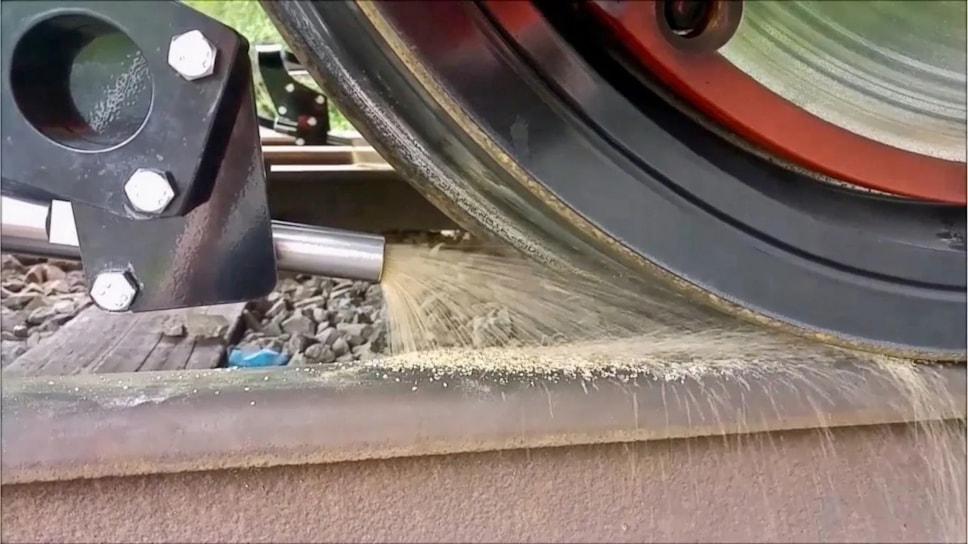
In the South West, Network Rail and SWR are collaborating to run leaf-busting passenger trains. Last year 39 SWR Class 158 and 159 trains were retrofitted with Network Rail-funded sand-applying technology to boost rail adhesion. The upgraded sand applicators release sand at variable rates based on train speed and track conditions, distributing up to 5kg of sand per minute and automatically applying sand when breaking to reduce stopping distances. After a successful first autumn in service, the trains will roll into action again this year.
In addition, for the first time this year, SWR is trialling Water-Trak on one Class 450 and one Class 444 train. During low adhesion conditions, the system applies a small amount of water from the trains onto the rail head. This helps the trains glide more easily along the rail in leafy conditions.
Neil Drury, South Western Railway Engineering and Infrastructure Director said: “The collaborative effort between us and Network Rail is critical to keep customers moving through the autumn.
“We are investing in technology and innovative trials that will help to prevent disruption, protect people’s journeys and can be scaled up to new parts of the network.”
Meanwhile, Northern are pioneering new technology to help clear the line and minimise disruption between Bishop Auckland and Darlington. A Northern train fitted with cryogenic cleaning equipment, known as Cryogrip is now running between scheduled passenger services.
The technology, developed by engineers from the University of Sheffield works by firing dry ice pellets at the railhead, in a stream of air at supersonic speed. Any leaves on the line are frozen and then blasted away as the dry ice pellets turn back into a gas.
If the trial is successful, Cryogrip can be used on trains carrying passengers in the future.
Northern, together with Network Rail and fellow publicly owned operator TransPennine Express invest more than £25 million every year to tackle the serious issue of leaves on the line and keep passengers moving safely across the North of England.
Notes to editors
The railway deploys a package of different measures across track and train to minimise the effects of leaf fall on train performance.
- In areas with heavy leaf fall some operators publish specific autumn timetables with revised journey times that give train drivers time to drive more cautiously if needed. Northern, South Eastern Railway and SWR have all implemented the necessary timetable changes to keep passengers moving safely.
- Operators map out the routes which are usually covered with leaves when the weather turns, and make sure drivers receive the latest guidance and regular weather forecasts so they can navigate the difficult conditions.
- Network Rail’s fleet of leaf-busting trains treat 1.12 million miles of track over the autumn to keep the track clean and journeys running smoothly. The tracks are sprayed with high powered water jets to blast away the leaves and then apply an adhesion modifying gel containing a mix of sand and steel grains that help trains to grip the rails.
- Network Rail also receive adhesion forecasts twice a day from a specialist weather forecaster, highlighting locations that require action and allowing them to manage their resources.
- Technology helps to determine the safest speeds during wet and windy weather and AI is used to identify locations where vegetation threats are greatest and how to best manage vegetation all year round.
- Drones are also being deployed to aerially inspect the railway and reduce the need for line closures while high-definition video cameras mounted onto the front of trains – known as Automated Intelligent Video Review (AIVR) – capture high-definition images and video to help maintenance teams identify any areas of track where the railhead has been contaminated by leaves or ice, so treatment can be focused in areas that need extra attention.